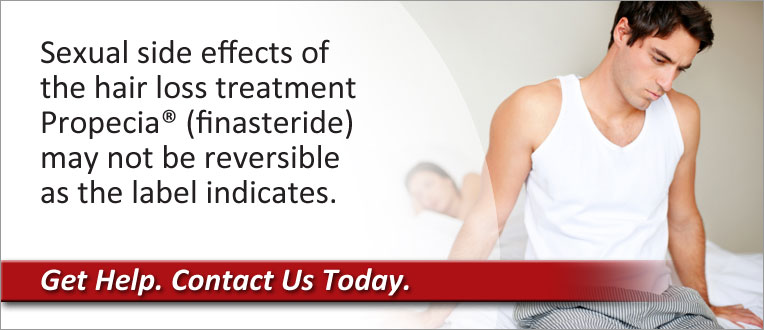
Have you taken Propecia® (finasteride) for Male Pattern Baldness and suffered persistent sexual side effects?
If you or your partner suffers from sexual dysfunction, including erectile dysfunction or impotence, loss of sexual desire, decreased arousal or problems with orgasm, and have taken the prescription hair loss treatment pill Propecia, these may be sexual side effects of the drug.
A hair loss treatment for Male Pattern Baldness
pattern baldness (androgenetic alopecia). This is a condition related to men’s genes and male sex hormones. Men with male pattern baldness start to experience a recession of the hairline on the top front of the head during their 20s – 40s. Their hairline recedes to form an “M” shape, then progresses until the top of the head is bald and a horseshoe of hair remains from one ear around the back of the head to the other ear.
More than one million men have used Propecia for their male pattern baldness since it came on the market in 1998. Propecia works by inhibiting an enzyme that converts testosterone in the body into DHT, a substance that can cause hair loss by shrinking hair follicles.
There are other hair loss treatments, including Rogaine (minoxidil) and surgical hair restoration.
Erectile Dysfunction and other sexual side effects of Propecia hair loss treatment
The labeling for Propecia sold in the United States tells users that a small number of patients in clinical studies experienced sexual side effects such as loss of sexual desire, impotence and decrease in semen volume. According to Merck & Co., Inc., the manufacturer of Propecia, those sexual side effects were reversible and disappeared after five years of Propecia use or after discontinuation of the drug.
However, men who have taken Propecia report they are experiencing persistent sexual side effects, those that have not gone away after discontinuing the drug, including:
- Loss of sexual desire
- Erectile dysfunction
- Decreased arousal
- Problems with orgasm
Dr. Michael S. Irwig, a professor at The George Washington University, and Swapna Kolukula MB, BS of the Greater Baltimore Medical Center performed a study to determine the types and duration of persistent sexual side effects occurring with this hair loss treatment. The researchers interviewed 71 men between the ages of 21 and 46 who had no history of sexual dysfunction before taking Propecia, but developed sexual side effects that lasted more than three months despite discontinuation of the medication.
Most men in the study suffered multiple sexual side effects, with 94% reporting a loss of sexual desire, 92% experiencing erectile dysfunction, 92% having decreased arousal and 69% developing problems with orgasm. The men had an average of twenty-six sexual episodes per month before taking Propecia and those episodes declined to just one third, or eight episodes per month, after using the medication. However, what made researchers wonder if these sexual side effects are permanent was the fact that twenty percent of men
Merck did not warn Americans about risks of potentially permanent sexual side effects
While Merck’s Propecia labeling in the U.S. does not carry any warning about persistent sexual dysfunction, labeling for the drug in other countries does. The United Kingdom’s Medicines and Healthcare Products Regulatory Agency and Sweden’s Medical Products Agency have required a warning on patient information leaflets after post marketing reports of persistent erectile dysfunction.
When men in America weigh the benefits of hair loss treatment with Propecia against the risk of potential sexual side effects, they are not getting all the facts. They might make a different choice if they knew the sexual side effects such as erectile dysfunction or impotence, loss of sexual desire or problems with orgasm may be permanent. Sexual dysfunction can be devastating to a man’s life and that of his family, reducing quality of life and causing depression, marital problems and even difficulty fathering children.
An estimated 15 to 30 million men in America suffer erectile dysfunction. Propecia is one of more than 200 prescription medications that have sexual side effects. There are other causes too, including certain health conditions. If you are experiencing any form of sexual dysfunction, speak with your doctor.
If you took Propecia and now suffer symptoms of sexual dysfunction we can help you achieve justice for how this drug has changed your life.
If you or your partner took Propecia for the treatment of hair loss from male pattern baldness and are now suffering persistent loss of sexual desire, erectile dysfunction or impotence, decreased arousal or problems with orgasm even after stopping the drug, you may have cause to file a Propecia lawsuit. Contact our lawyers today for a free legal consultation to learn your rights.

Cases and Settlements of Note
FDA Lawsuits & Settlements
- Diet Drug (Phentermine, fenfluramine, dexfenfluramine) Products Liability Litigation. The firm achieved a landmark settlement of half-a-billion dollars on behalf of thousands of plaintiffs injured as a result of their ingestion of defective diet medications.
- Client v. Bayer Corporation. The firm achieved settlements totaling over $1M on behalf of plaintiffs injured as a result of being administered the defective drug Trasylol during heart surgery.

Attorney Advertising: Prior results do not guarantee a similar outcome. This website is for informational purposes only, does not constitute legal advice and may not reflect the most current legal developments. Use of this website does not create an attorney-client relationship, only a written contract between the parties can establish an attorney-client relationship. Napoli Bern Ripka Shkolnik LLP and all contributing authors expressly disclaim all liability to any person with respect to the contents of this website. Imagery used on this website utilizes fictionalized events or scenes with participation of models. For complete details, read our Terms of Use and Privacy Policy.
(888) 529 4669