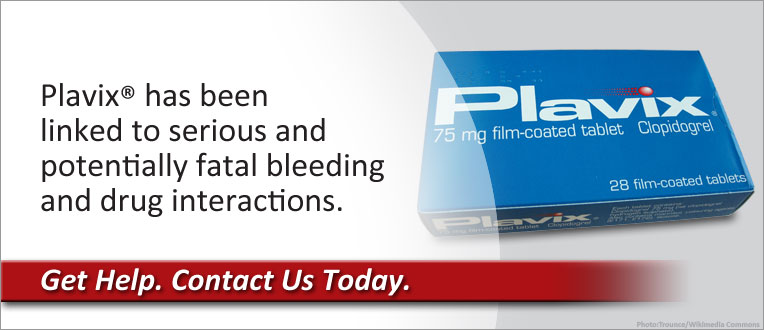
If you or a loved one suffered internal bleeding, ulcers or gastrointestinal bleeding, TTP, bleeding or hemorrhagic stroke s while taking the anti-clotting drug Plavix® (clopidogrel), you may have cause for a Plavix Lawsuit
The attorneys of Napoli Bern Ripka Shkolnik LLP are reviewing potential Plavix lawsuits throughout the United States for people who have suffered serious Plavix side effects. If Plavix side effects have affected your life, or the life of your loved one, you can have your case reviewed by our attorneys, who focus their practice on obtaining justice for people injured by defective prescription drugs, in a free consultation where you will learn your legal rights and options.
The U.S. Food and Drug Administration (FDA) approved Plavix (clopidogrel) in 1997. Doctors prescribe this drug for the prevention of blood clots in patients who have had a bleeding or hemorrhagic stroke or heart attack, including Acute Coronary Syndrome or Myocardial Infarction, or those diagnosed with Peripheral Arterial Disease (PAD). (1)
Marketed by a partnership of Sanofi-Aventis and Bristol-Myers Squibb, Plavix is an antiplatelet drug that works by preventing platelets in the blood from sticking together and forming clots.
In 2010, $4.6 billion in retail sales made Plavix #3 on a list of Top 200 Pharmaceutical Sales in the U.S. (2)
You may have a Plavix lawsuit if you, or a family member, suffered these Plavix side effects:
- Internal bleeding
- Gastrointestinal bleeding
- Cerebral bleeding or Hemorrhage
- Ulcers
- Heart attack
- Bleeding Stroke
- Hemorrhagic Stroke
- Thrombotic Thrombocytopenic Purpora (TTP), a disorder in which blood clots form in the small blood vessels around the body, including the kidneys, heart and brain, that can restrict or block blood flow and which may result in brain damage, stroke or even death. (3)
- Death resulting from internal bleeding
Plavix can cause Ulcers, Gastrointestinal Bleeding and Internal Bleeding
People may not have known or understood the risks for serious Plavix side effects when they took this drug. Plavix reduces the bloods ability to form a clot and is associated with major internal bleeding and gastrointestinal bleeding. Bleeding during surgery or from injury could also be fatal while taking Plavix.
While the American College of Cardiology and American Heart Association have considered Plavix an alternative anti-clotting drug for patients who suffer gastrointestinal intolerance to aspirin, some doctors no longer support this recommendation based upon study results showing aspirin plus esomeprazole was superior to clopidogrel in the prevention of recurrent bleeding of ulcers. (4)
Plavix is also associated with the development of ulcers. A Plavix trial found that people taking Plavix might suffer more than 12 times as many ulcers as patients who take aspirin plus esomeprazole. (5)
Plavix Drug Interactions with Proton Pump Inhibitors (PPIs)
Because Plavix side effects can include ulcers and gastrointestinal bleeding, doctors often prescribe Proton Pump Inhibitors (PPI’s) to reduce stomach acid in patients taking Plavix. (6)
In November 2009, the FDA released an advisory saying that taking the Proton Pump Inhibitor omeprazole (marketed as Prilosec/Prilosec OTC) in conjunction with Plavix significantly reduced the effectiveness of Plavix and patients at risk for heart attack or stroke may not be getting the anti-clotting benefits. The makers of Plavix agreed to update the drug labeling to include a warning about drug interaction with omeprazole and to conduct further studies into other drug interactions. (7)
The FDA recommended doctors also avoid prescribing esomeprazole (Nexium), cimetidine (Tagamet/Tagamet HB), fluconazole (Diflucan), ketoconazole (Nizoral), voriconazole (VFEND), etravirine (Intelence), felbamate (Felbatol), fluoxetine (Prozac, Serafem, Symbyax), fluvoxamine (Luvox), and ticlopidine (Ticlid) in combination with Plavix because they are expected to have a similar effect on Plavix. (8)
Get help. Find out if you have a Plavix lawsuit today.
Napoli, Bern, Ripka & Shkolnik, LLP is offering a free consultation for people across the United States who have suffered serious Plavix side effects who may have reason to file a Plavix lawsuit. If you or a loved one took Plavix and suffered Thrombotic Thrombocytopenic Purpora, ulcers or internal bleeding such as gastrointestinal bleeding, or took Plavix in combination with omeprazole or other drug and suffered a bleeding or hemorrhagic stroke, you may have valuable legal rights. Find out how the attorneys of Napoli Bern Ripka Shkolnik LLP can help you get the justice you deserve.
(1) sanofi-aventis and Bristol-Myers Squibb. (2011, 5). PLAVIX (clopidogrel bisulfate) tablets. Retrieved November 8, 2011, from U.S. Food and Drug Administration: http://www.accessdata.fda.gov/drugsatfda_docs/label/2011/020839s051lbl.pdf
(2) Drugs.com. (2010). Pharmaceutical Sales 2010. Retrieved November 8, 2011, from http://www.drugs.com/top200.html
(3) U.S. Department of Health & Human Services, National Heart Lung and Blood Institute. (2011, November 4). What Is Thrombotic Thrombocytopenic Purpura? Retrieved November 8, 2011, from National Heart Lung and Blood Institute: http://www.nhlbi.nih.gov/health/health-topics/topics/ttp/
(4) Chan, F. K., Ching, J. Y., Hung, L. C., Wong, V. W., Leung, V. K., Kung, N. N., et al. (2005). Clopidogrel versus Aspirin and Esomeprazole to Prevent Recurrent Ulcer Bleeding. The New England Journal of Medicine , 352:238-244 - http://www.nejm.org/doi/full/10.1056/NEJMoa042087#t=abstract.
(5) Drugs.com. (n.d.). Plavix Side Effects. Retrieved November 8, 2011, from http://www.drugs.com/sfx/plavix-side-effects.html
(6) U.S. Department of Health & Human Services, U.S. Food and Drug Administration. (2009, January 26). Early Communication about an Ongoing Safety Review of clopidogrel bisulfate (marketed as Plavix). Retrieved November 8, 2011, from U.S. Food and Drug Administration: http://www.fda.gov/Drugs/DrugSafety/PostmarketDrugSafety
InformationforPatientsandProviders/DrugSafetyInformationfor
HeathcareProfessionals/ucm079520.htm
(7) U.S. Department of Health & Human Services, U.S. Food and Drug Administration. (2009, November 17). Public Health Advisory: Updated Safety Information about a drug interaction between Clopidogrel Bisulfate (marketed as Plavix) and Omeprazole (marketed as Prilosec and Prilosec OTC). Retrieved November 8, 2011, from U.S. Food and Drug Administration: http://www.fda.gov/Drugs/DrugSafety/PostmarketDrugSafety
InformationforPatientsandProviders/DrugSafetyInformationfor
HeathcareProfessionals/PublicHealthAdvisories/ucm190825.htm
(8) U.S. Department of Health & Human Services, U.S. Food and Drug Administration. (2009, November 17). Information for Healthcare Professionals: Update to the labeling of Clopidogrel Bisulfate (marketed as Plavix) to alert healthcare professionals about a drug interaction with omeprazole (marketed as Prilosec and Prilosec OTC). Retrieved November 8, 2011, from U.S. Food and Drug Administration: http://www.fda.gov/Drugs/DrugSafety/Postmarket
DrugSafetyInformationforPatientsandProviders/DrugSafety
InformationforHeathcareProfessionals/ucm190787.htm
FDA Lawsuits
Prescription medications are a valuable resource for many people suffering acute or chronic medical conditions. Most Americans will take a pharmaceutical drug at some point in their life. When pharmaceutical companies test these medications for safety and ensure labeling carries clear directions and warnings of possible medication side effects or drug interactions, these medications may substantially increase the quality of life and life expectancy.
Unfortunately, serious or potentially fatal adverse medication side effects of many pharmaceutical drugs only become known after they have been on the market for a while and large numbers of people are affected. The U.S. Food and Drug Administration (FDA) regulates pharmaceutical drugs. However, defective drugs sometimes make it to the market because the pharmaceutical company did not disclose the drug side effects during clinical trials or communicate the consequences of long-term use. When this occurs, the FDA requires an update to the labeling to warn of drug side effects risk or determines it is a defective drug and issues a drug recall. If the drug company fails to do this, you and your doctor have no way to know the dangers. People affected by defective drugs should consult with a personal injury lawyer such as Napoli Bern Ripka Shkolnik LLP to find out their legal options.
The FDA approves drugs based partly on efficacy and drug side effects of clinical trials, and pharmaceutical companies sometimes perform clinical trials after a drug is on the market, but the way the pharmaceutical industry performs clinical trials has fallen under scrutiny.
A 2010 report by the U.S. Department of Health and Human Services found that prescription drug trials conducted outside the United States and used as a basis for U.S. drug approvals lack oversight by the FDA. In 2008, 80% of FDA drug approvals were based in part on foreign clinical trial data. 8% included only foreign study data. Yet in 2008, the FDA inspected less than 1% of foreign clinical trial sites. The investigation also found the FDA is completely unaware of many foreign clinical trials or their results because pharmaceutical companies or drug sponsors often do not submit Investigational New Drug (IND) forms to notify the agency.
A study funded by the U.S. government and published August 2010 in Annals of Internal Medicine entitled “Outcome Reporting among Drug Trials Registered in ClinicalTrials.gov” examined 546 clinical drug trials conducted between 2000 and 2006. The study found that clinical trials funded by the pharmaceutical industry were dramatically more likely to report positive drug outcomes than were trials funded by other sources.
Just in September 2010, the FDA changed requirements for reporting risks or adverse reactions found during clinical trials, after an inquiry by the Senate Committee on Finance, who oversees the FDA, found that pharmaceutical giant GlaxoSmithKline knew of potential cardiac risks of the company’s prescription drug Avandia (rosiglitazone) years before it became public and failed to disclose those risks. The FDA first approved Avandia in 1999. Between then and when heart attack side effects came to public light in 2007, the FDA estimates that Avandia caused approximately 83,000 heart attacks. The new FDA rule requires that pharmaceutical companies or drug sponsors report clinical trial findings that suggest a significant risk to study participants or any suspected adverse reactions that occur at a rate higher than expected, which previously did not require reporting to the FDA, within 15 days of becoming aware of findings.
The FDA also regulates medical devices, everything from tongue depressors to heart valves, including medical implants such as hip replacements, diagnostic devices such as MRI machines and treatment devices such as infusion pumps. New medical devices must go through a premarket approval (PMA) and requires makers of the medical device to provide clinical trial data to prove the medical device is safe and effective. However, many new medical devices never go through this process. If a maker can prove their device is substantially similar to another device already approved for market, that device can get FDA approval through the 510(k) process that requires no clinical trial data support.
This FDA fast track process for medical device approvals is facing scrutiny from a U.S. Senate Special Committee after a study published in the February 2011 issue of Archives of Internal Medicine found that the majority of defective medical devices recalled by the FDA due to serious or fatal device side effects were approved using the 510(k) process. Defective medical devices have affected the lives of millions of people, including such medical devices as defective hip implants, defective defibrillators and defective infusion pumps.
Many serious and potentially fatal injuries from a defective medical device, medication side effects or drug interactions discovered after a medical device or drug has been on the market have prompted increased warnings on the device or drug labeling, restriction of the drug’s use or resulted in a medical device or drug recall. Anyone who suffers serious side effects from defective medical device or prescription medication, or those who lost a loved one to a fatal side effect, may have grounds to file a lawsuit to recover damages such as medical expenses, loss of wages or financial support or the wrongful death of a loved one. Speak with a personal injury lawyer of Napoli Bern Ripka Shkolnik LLP today and find out if you are entitled to compensation for your injury.

Cases and Settlements of Note
FDA Lawsuits & Settlements
- Diet Drug (Phentermine, fenfluramine, dexfenfluramine) Products Liability Litigation. The firm achieved a landmark settlement of half-a-billion dollars on behalf of thousands of plaintiffs injured as a result of their ingestion of defective diet medications.
- Client v. Bayer Corporation. The firm achieved settlements totaling over $1M on behalf of plaintiffs injured as a result of being administered the defective drug Trasylol during heart surgery.

Attorney Advertising: Prior results do not guarantee a similar outcome. This website is for informational purposes only, does not constitute legal advice and may not reflect the most current legal developments. Use of this website does not create an attorney-client relationship, only a written contract between the parties can establish an attorney-client relationship. Napoli Bern Ripka Shkolnik LLP and all contributing authors expressly disclaim all liability to any person with respect to the contents of this website. Imagery used on this website utilizes fictionalized events or scenes with participation of models. For complete details, read our Terms of Use and Privacy Policy.
(888) 529 4669